 High Performance Center »Functional Integration in Micro- and Nanoelectronics«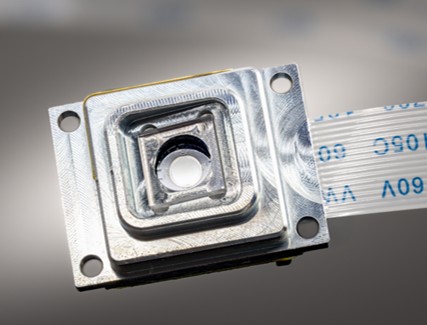
New Application Opportunities for Miniaturized Optical Systems
Many laser applications in medicine and industry require vectorial (i.e., 2D quasi-static) scanning systems for dynamic and precise beam positioning along freely selectable scan trajectories. Currently, conventional galvanometer scanners with serial mirror arrangements are predominantly used. However, these systems have a relatively large form factor, high power consumption, and high cost. While MEMS scanning mirrors can be used to achieve further miniaturization and cost reduction of the scanning system, conventional resonant or raster-scanning MEMS scanners are limited to periodic scan trajectories.
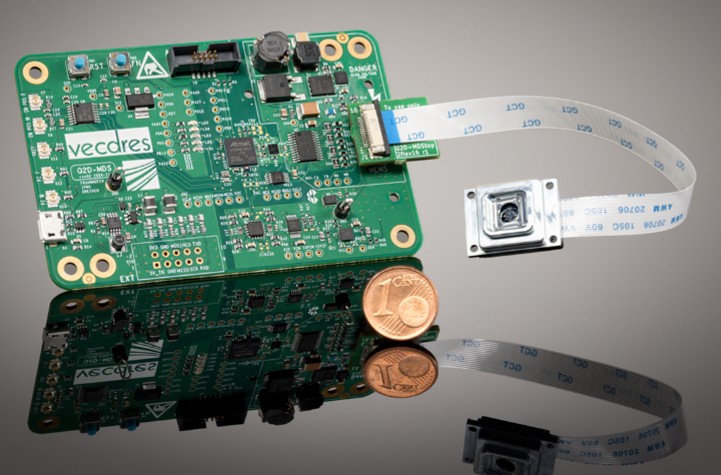
In the recently completed publicly funded Eurostars project UltraLASE, Fraunhofer IPMS developed a prototype of a compact MEMS vector scanning module, specifically optimized to meet the requirements of highly compact laser photocoagulation systems for the treatment of retinal diseases. The vectorial MEMS scanning module features integrated position sensing and is suitable for increased laser power due to its highly reflective optical coating.
However, its compact dimensions and low power consumption make the module potentially suitable for a wide range of highly miniaturized and highly portable laser applications in medicine and industry. These include, for example, optical diagnostic systems (OCT- or fluorescence-based) for ophthalmology, dermatology, or point-of-care applications; therapeutic laser systems, such as handheld laser surgery instruments for soft-tissue cutting (e.g., laryngoscopes) and industrial sensor applications, such as laser process monitoring, LIDAR systems, free-space optical (FSO) communication, or high-speed optical switching.
In the present technology transfer project, the assembly processes and performance characteristics of the vectorial MEMS scanning module will be further optimized, followed by the production of a small series of demonstrators (CEKs). The CEKs are intended to enable industrial customers and research institutions to rapidly evaluate and explore additional applications for vectorial MEMS scanners.
Objectives:
- Optimization of the MEMS scanning module's micro-assembly (cost reduction and increased yield) to establish it as a reproducible industrial offering
- Increasing the damping of the scanning system to improve positioning dynamics
- Production of a small series of demonstrators (CEKs) for evaluation by industrial customers